
Upcoming Journal Publication
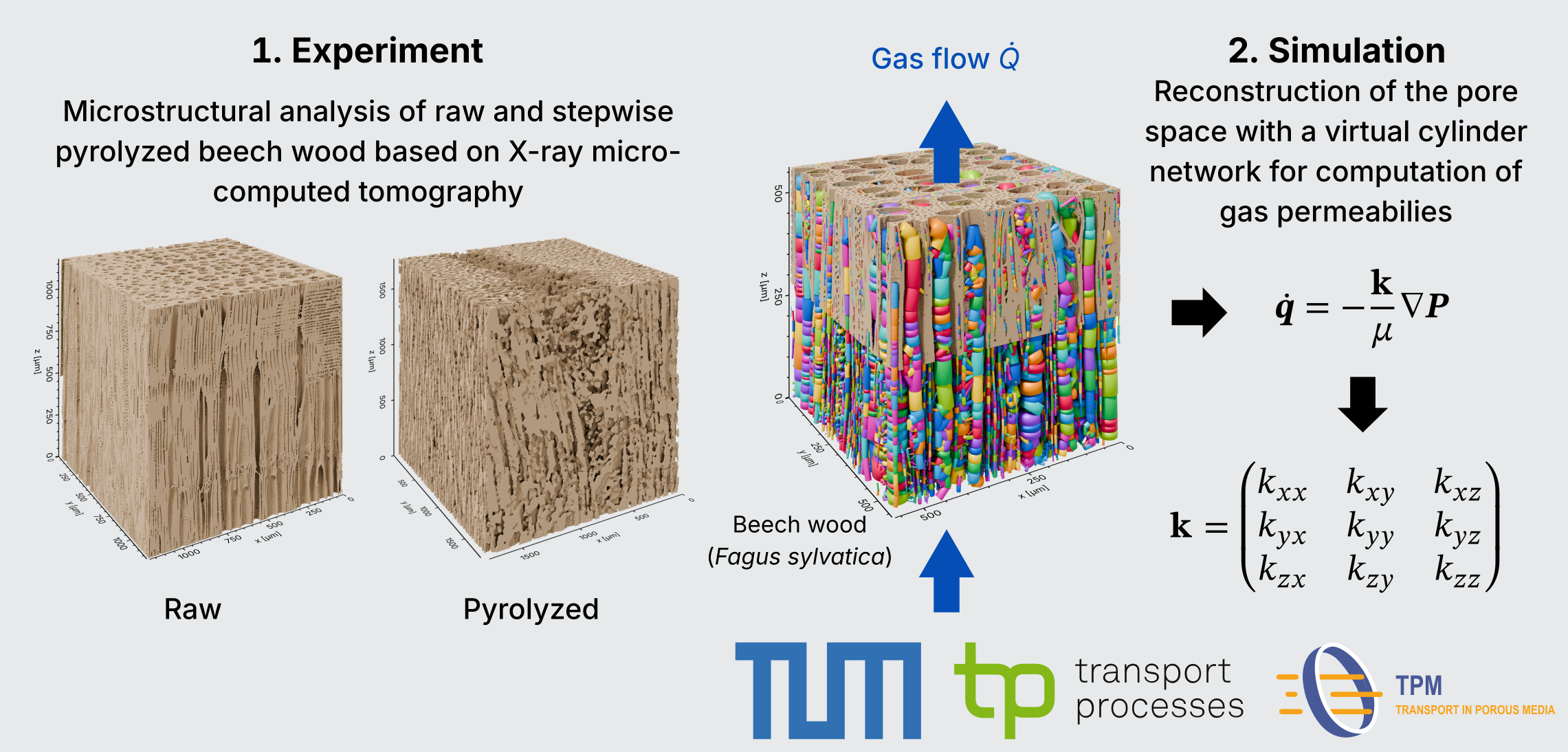
Anisotropic permeability tensors of raw and gradually pyrolyzed beech wood (Fagus sylvatica) from pore network simulations
Gas transport within wood plays a crucial role during thermochemical conversion processes such as pyrolysis. This study investigates the anisotropic gas permeability of raw and gradually pyrolyzed beech wood (Fagus sylvatica) using a pore network modeling (PNM) approach.
High‑resolution X‑ray micro‑computed tomography (µ-CT) was used to reconstruct the three‑dimensional pore structure of beech wood before and after stepwise pyrolysis up to 500 °C. Based on these structures, Darcy permeability tensors were calculated for all three main anatomical directions (radial, tangential, and longitudinal) under laminar gas flow conditions. The results were validated against experimental literature data for raw wood and pore‑resolved CFD simulations applied to the same pyrolyzed structures.
The analysis reveals a strongly anisotropic transport behavior. In raw wood, gas flow occurs almost exclusively through the large longitudinal vessels, while permeability perpendicular to the fiber direction is negligible. During pyrolysis, however, pore connectivity increases significantly in the radial and tangential directions, leading to permeability enhancements of up to two orders of magnitude transverse to the main vessel orientation. In contrast, longitudinal permeability remains nearly constant at approximately 10⁻¹¹ m² across all conversion stages.
A systematic comparison between pore network simulations and CFD results enabled the derivation of direction‑dependent correction factors for the Hagen–Poiseuille approach used in the PNM, resulting in very good agreement between both methods. Overall, the study demonstrates that pore network modeling provides an efficient and robust framework for quantifying anisotropic gas transport in wood and offers a valuable basis for advanced particle‑scale models of biomass pyrolysis.