Microwave Drying of Bricks and Tiles

Information
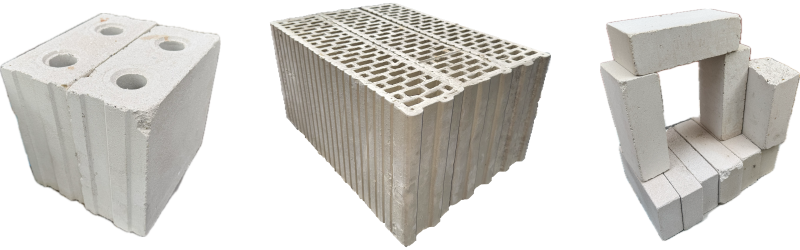
Bricks and roof tiles are among the oldest building materials and are still produced in very large volumes. Before firing, every freshly formed (“green”) brick must lose most of its water – close to a fifth of its wet mass – slowly enough that it does not crack. Today this takes between half a day and several days and runs largely on natural gas and recovered kiln heat.
Microwave drying can do the same job with electricity from renewable sources and in a fraction of the time. For almost a decade, we have been working out how to make it fast, energy-efficient and safe for the product – from small clay samples to full-size roof tiles, facing bricks, perforated bricks and sanitary ceramics.
Drying is one of the most energy- and time-intensive steps in brick and tile production. The process is slow for physical reasons. Wet clay has very fine pores and conducts heat poorly (below 1 W/(m·K)), so heat from hot air reaches the inside of the product only gradually. At the same time, air temperatures must stay low at the start of drying (often below 30–40 °C) to avoid cracks. In the industrial schedule we used as a reference, facing bricks take about 80 hours to dry.
Microwaves heat the water inside the product directly. The electromagnetic field, at 2.45 GHz or 915 MHz, makes the water molecules oscillate, and this motion is converted into heat throughout the volume. No hot air has to carry the heat in from outside: in our tests, the core of a facing brick exceeded 50 °C within the first hour, whereas with hot air alone it took well over ten hours to pass 40 °C. Heat and moisture then move in the same direction, from the inside outwards – the reverse of conventional drying.
This advantage comes with three challenges, especially for large and moist products:
- Limited penetration depth. Wet clay absorbs microwaves strongly. In a wet roof tile, the field at 2.45 GHz penetrates only about 3 cm at the start of drying and more than 15 cm towards the end. Edges and corners therefore heat up faster than the core.
- Hot spots. The field inside a dryer is never perfectly uniform. Where it is strong, water evaporates faster than the vapour can escape through the fine pores. Pressure builds up, liquid is pushed out, and the product can crack.
- A moving target. The dielectric properties change with moisture content and temperature, and the product itself reshapes the field. A dryer operating point that works at the start of drying can overheat the product later on.
Our early experiments showed that cracking depends less on the maximum temperature than on the moisture content and size of the product. Controlling a microwave dryer by temperature alone is therefore not enough: the transport of liquid and vapour inside the pores has to be taken into account.
Our concept is intermittent microwave heating combined with convective air flow. Short, intense microwave pulses of a few seconds (for example 10 s) alternate with pauses of about 85 s. During each pause, temperature differences inside the product even out and the vapour has time to escape. A temperature limit, usually 65 °C, interrupts heating whenever needed.
We study the process on three levels:
- Experiments on real products. Our lab-scale microwave dryer (Püschner, 2.45 GHz, 3 kW) takes single products of up to 20 kg. It combines a turntable on a balance, a mode stirrer, adjustable air temperature and humidity, infrared cameras for surface temperatures and fibre-optic sensors for temperatures inside the product. We have dried industrially formed roof tiles, facing bricks, perforated bricks and sanitary ceramics.
- Measurement methods. Distributed fibre-optic sensing resolves the temperature along a line through a brick while it dries. The dielectric properties of the clays are determined as a function of their moisture content.
- Simulation. Coupled models of the electromagnetic field, heat and moisture transport (COMSOL Multiphysics) form a digital twin of the lab dryer. Because the field is hard to predict exactly, we validate the models against measured temperatures rather than field strengths.
Research partners
| Dr.-Ing. Anne Tretau |
Materialforschungs- und -prüfanstalt an der Bauhaus-Universität Weimar Coudraystraße 4/9 |
|---|---|
| Dr. rer. nat. Ralf Wagner |
Materialforschungs- und -prüfanstalt an der Bauhaus-Universität Weimar Coudraystraße 4/9 |
Publications
| Briest, L., Wagner, R., Tretau, A., Tsotsas, E., & Vorhauer-Huget, N. (2022). Microwave-assisted drying of clay roof tiles. Drying Technology, 40(9), 1804–1818 doi.org/10.1080/07373937.2021.1878369 |
| Vorhauer-Huget, N., Briest, L., Wagner, R., Tretau, A., Rahimi, A., & Tsotsas, E. (2022). Using microwave heating for electrification of the drying of green heavy clay products. Brick and Tile Industry International, 2022(03). zi-online.info |
| Briest, L., Tsotsas, E., & Vorhauer-Huget, N. (2021). Experimentelle Untersuchung der Mikrowellentrocknung von Sanitärkeramiken. Keramische Zeitschrift, 73(2), 36 – 43. doi.org/10.1007/s42410-021-0472-5 |
| Vorhauer, N., Tretau, A., Bück, A., & Prat, M. (2019). Microwave drying of wet clay with intermittent heating. Drying Technology, 37(5), 664 – 678 doi.org/10.1080/07373937.2018.1547740 |
Projects
-
Influence of process control on the energy requirements of microwave dryers (Einfluss der Prozessführung auf den Energiebedarf von Mikrowellentrocknern).
2024 – 2026
Funded by the Bundesministerium für Wirtschaft und Klimaschutz (BMWK, Federal Ministry of Economic Affairs and Climate Action) as part of the Industrielle Gemeinschaftsforschung (IGF) program on the basis of a resolution of the German Bundestag – IGF 01IF23309 N. -
Intermittent microwave drying for the brick and tile industry.
2020 – 2022
Funded by the Bundesministerium für Wirtschaft und Klimaschutz (BMWK, Federal Ministry of Economic Affairs and Climate Action) as part of the Industrielle Gemeinschaftsforschung (IGF) program on the basis of a resolution of the German Bundestag – IGF 20919 BG.