Freeze-Drying
Information
Freeze-drying or lyophilization is a necessary and common process for manufacturing of high-quality products. It finds its most applications in food and pharmaceutical industries for both, thermally and mechanically sensitive materials. Examples for commercially available freeze-dried products are fruits, coffee, meat and fish, as well as vaccines, antibiotics, and antibodies.
In short, the process of freeze-drying starts with freezing of the product to temperatures of about −20 °C up to −60 °C. During this step, water insides the pore space of the product turns from liquid into solid state. In a next step, the frozen product is placed into vacuum with pressures well below 100 Pa, which initiates the primary freeze-drying period. Frozen water, i.e. ice, turns directly from solid state into water vapor by sublimation. This phase transition demands comparably much heat, i.e. around 2.8 MJ/kg, which has to be supplied externally. In order to prevent product damage, the heat supply is limited by several safety parameters, e.g. collapse temperature.
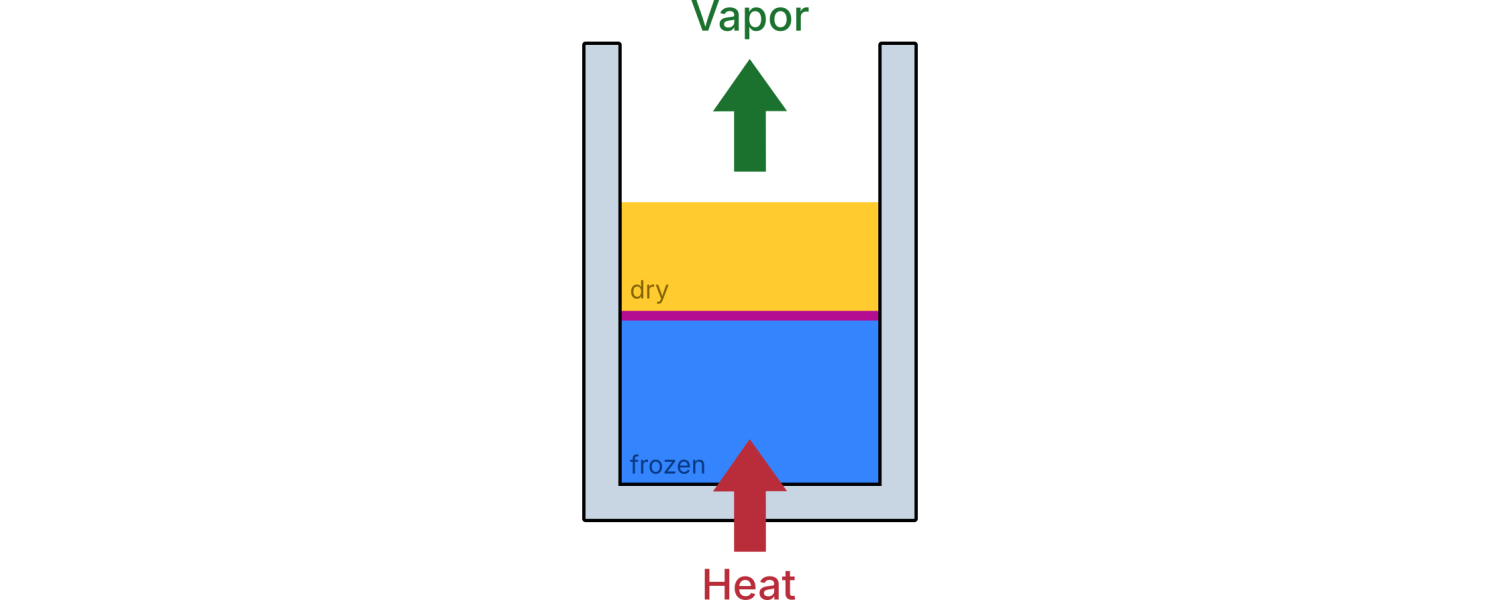
This makes the process slow and expensive. Attempts to increase efficiency quickly bring the process into areas where the solid structure of the product can soften and collapse. Such damaging events are always local and therefore cannot be captured by continuum models, which are limited in their informative value.
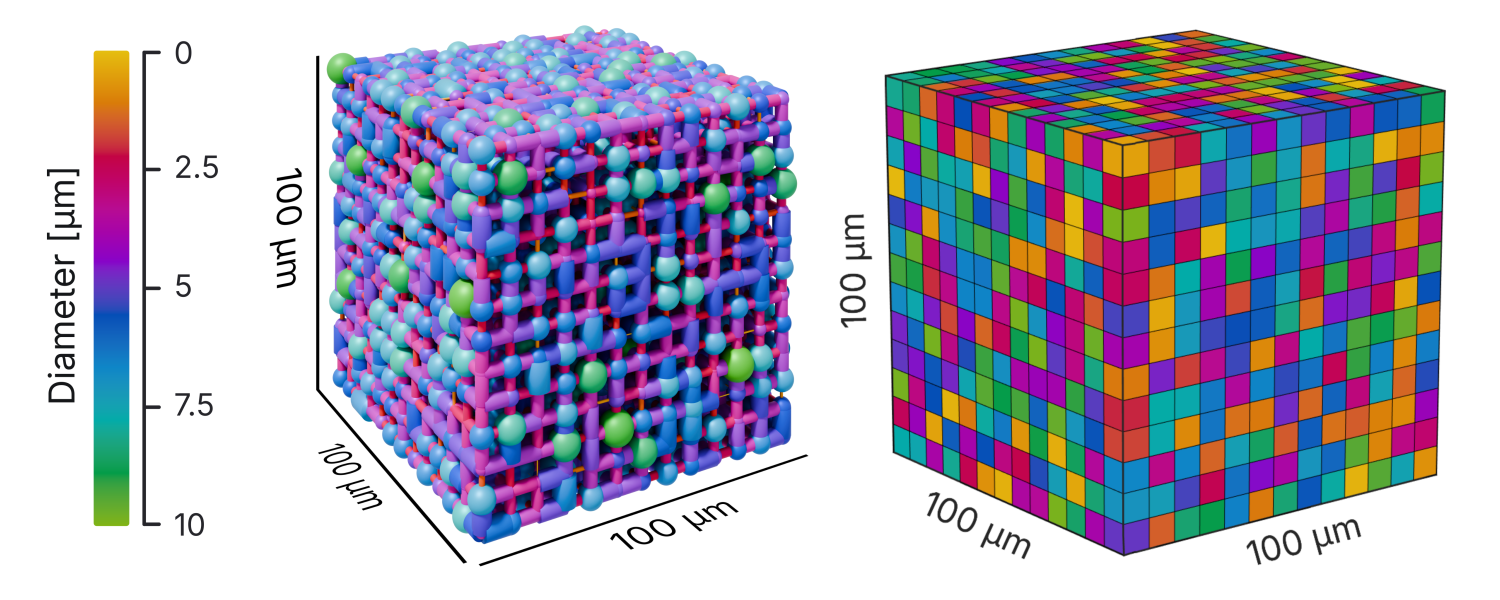
For this reason, we have developed a pore network model for freeze-drying that directly maps the microscale for the first time. The pore network is three-dimensional and irregular. It takes into account the local, pore-scale variation of heat and mass transfer as well as the structure and properties of the body to be dried, with two-way coupling between heat transfer and drying.
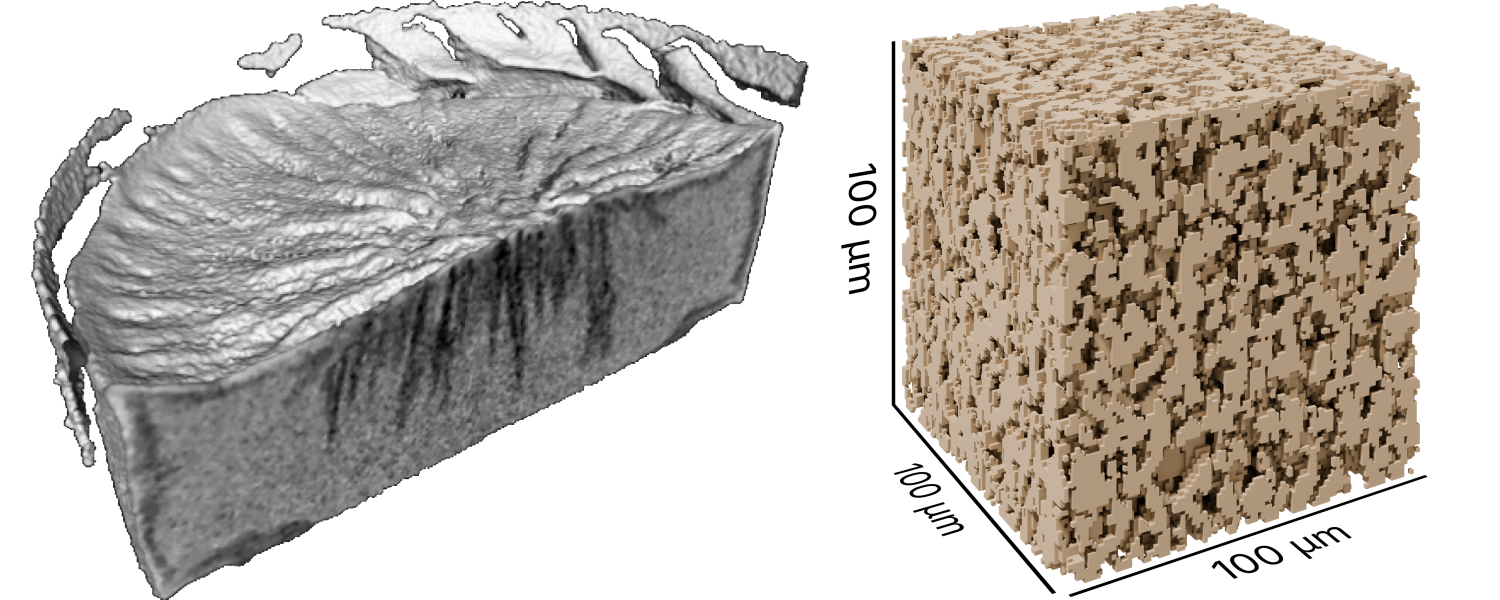
Experiments of freezing and subsequent freeze-drying of aqueous sugar solutions in the lyomicroscope have guide the model development. Freezing is very important here because, depending on the cooling rate, it produces the solid structure around ice crystals of different sizes and shapes that are subsequently to be dried. The morphology of the frozen or dried body is evaluated from three-dimensional X-ray tomography data and is used to generate the pore network realistically. The pore network model is finally parameterized and validated with the help of freeze-drying experiments both away from and in the area of structural collapse.
Research partners
|
Prof. Dr.-Ing. Petra Först |
Technische Universität München Weihenstephaner Berg 1 |
|---|
Publications
| Faber, F., Gruber, S., Foerst, P., Tsotsas, E., & Vorhauer-Huget, N. (2026). Assessment of non-isothermal pore network modeling of freeze-drying using 4D X-ray imaging. Chemical Engineering Journal, 172870 doi.org/10.1016/j.cej.2026.172870 |
| Faber, F., Vorhauer-Huget, N., Thomik, M., Gruber, S., Först, P., & Tsotsas, E. (2025). Pore-scale study of coupled heat and mass transfer during primary freeze-drying using an irregular pore network model. Drying Technology, 43(1-2), 162 – 182 doi.org/10.1080/07373937.2024.2407062 |
| Gruber, S., Greiner, J., Eppink, A., Thomik, M., Coppens, F., Vorhauer-Huget, N., Tsotsas, E., & Foerst, P. (2024). Pore shape matters – In-situ investigation of freeze-drying kinetics by 4D XCT methods. Food Research International, 193, 114837 doi.org/10.1016/j.foodres.2024.114837 |
| Thomik, M., Faber, F., Gruber, S., Foerst, P., Tsotsas, E., & Vorhauer-Huget, N. (2023). A Non-Isothermal Pore Network Model of Primary Freeze Drying. Pharmaceutics, 15(8), 2131 doi.org/10.3390/pharmaceutics15082131 |
| Gruber, S., Thomik, M., Vorhauer-Huget, N., Hans, L., Tsotsas, E., & Foerst, P. (2022). The Influence of Local Microstructure Inhomogeneities on Local Drying Kinetics during Freeze-Drying. Pharmaceutics, 14(10), 2132 doi.org/10.3390/pharmaceutics14102132 |
| Thomik, M., Gruber, S., Kaestner, A., Foerst, P., Tsotsas, E., & Vorhauer-Huget, N. (2022). Experimental Study of the Impact of Pore Structure on Drying Kinetics and Sublimation Front Patterns. Pharmaceutics, 14(8), 1538 doi.org/10.3390/pharmaceutics14081538 |
| Thomik, M., Gruber, S., Foerst, P., Tsotsas, E., & Vorhauer-Huget, N. (2022). Determination of 3D pore network structure of freeze-dried maltodextrin. Drying Technology, 40(4), 748 – 766 doi.org/10.1080/07373937.2021.1966030 |
| Gruber, S., Vorhauer-Huget, N., & Foerst, P. (2021). In situ micro-computed tomography to study microstructure and sublimation front during freeze-drying. Food Structure, 29, 100213 doi.org/10.1016/j.foostr.2021.100213 |
| Vorhauer-Huget, N., Mannes, D., Hilmer, M., Gruber, S., Strobl, M., Tsotsas, E., & Foerst, P. (2020). Freeze-Drying with Structured Sublimation Fronts—Visualization with Neutron Imaging. Processes, 8(9), 1091 doi.org/10.3390/pr8091091 |
| Foerst, P., Gruber, S., Schulz, M., Vorhauer, N., & Tsotsas, E. (2020). Characterization of Lyophilization of Frozen Bulky Solids. Chemical Engineering & Technology, 43(5), 789 – 796 doi.org/10.1002/ceat.201900500 |
| Gruber, S., Vorhauer, N., Schulz, M., Hilmer, M., Peters, J., Tsotsas, E., & Foerst, P. (2020). Estimation of the local sublimation front velocities from neutron radiography and tomography of particulate matter. Chemical Engineering Science, 211, 115268 doi.org/10.1016/j.ces.2019.115268 |
| Hilmer, M., Peters, J., Schulz, M., Gruber, S., Vorhauer, N., Tsotsas, E., & Foerst, P. (2020). Development of an experimental setup for in situ visualization of lyophilization using neutron radiography and computed tomography. Review of Scientific Instruments, 91(1), 014102 doi.org/10.1063/1.5126927 |
Projects
-
Pore network modeling of freeze-drying based on lyomicroscopic and tomographic measurements.
2018 – 2023
Funded by the Deutsche Forschungsgemeinschaft (DFG, German Research Foundation) – 413284489.