
IGF-Project – Microwave drying of bricks and tiles
Influence of process control on the energy requirements of microwave dryers
Abstract
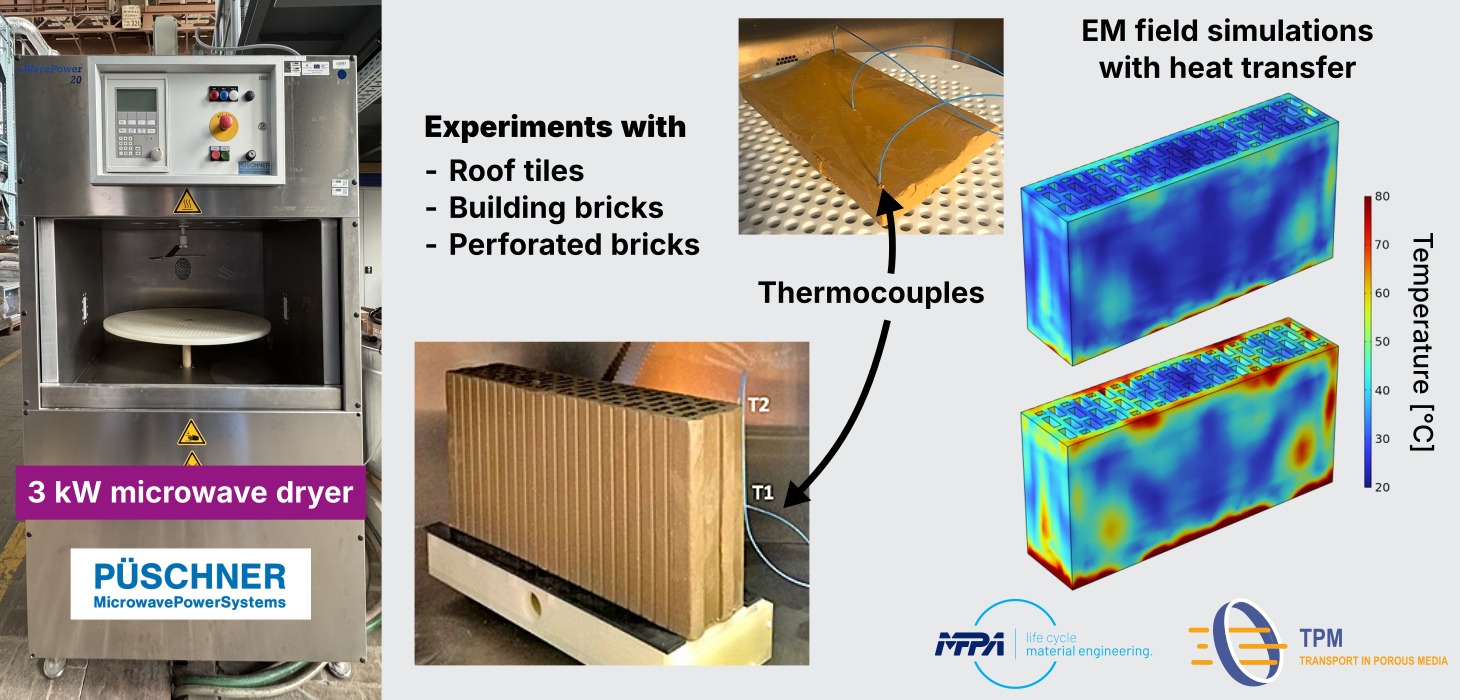
Bricks belong to the oldest building materials, which are still in frequent use and of great importance. Traditional convective drying methods typically used in nowadays manufacturing processes rely on fossil fuels, producing a heavy carbon footprint.
Microwave drying offers potential for electrification and process intensification, allowing faster, more energy-efficient drying with less environmental impact. Our research addresses the challenges of uneven heating, hot spots, and mechanical stress in brick blanks. By examining the interaction between electromagnetic radiation, material properties, and airflow, we aim to optimize the drying process. The findings will support the industrial application of scalable microwave dryers, contributing to energy efficiency and climate-neutral production.
Research partner
|
Dr.-Ing. Anne Tretau
|
Materialforschungs- und -prüfanstalt an der Bauhaus-Universität Weimar Coudraystraße 4/9 |
|---|---|
|
Dr. rer. nat. Ralf Wagner
|
Materialforschungs- und -prüfanstalt an der Bauhaus-Universität Weimar Coudraystraße 4/9 |
Funding
This IGF project is supported within the programme for promoting the Industrial Collective Research (IGF) of the German Federal Ministry for Economic Affairs and Energy (BMWE) on the basis of a decision by the German Bundestag.
- Project title (German): Einfluss der Prozessführung auf den Energiebedarf von Mikrowellentrockner
- Project number: 01IF23309N
- Project duration: 05/2024 - 10/2026