Microwave Pyrolysis
Information
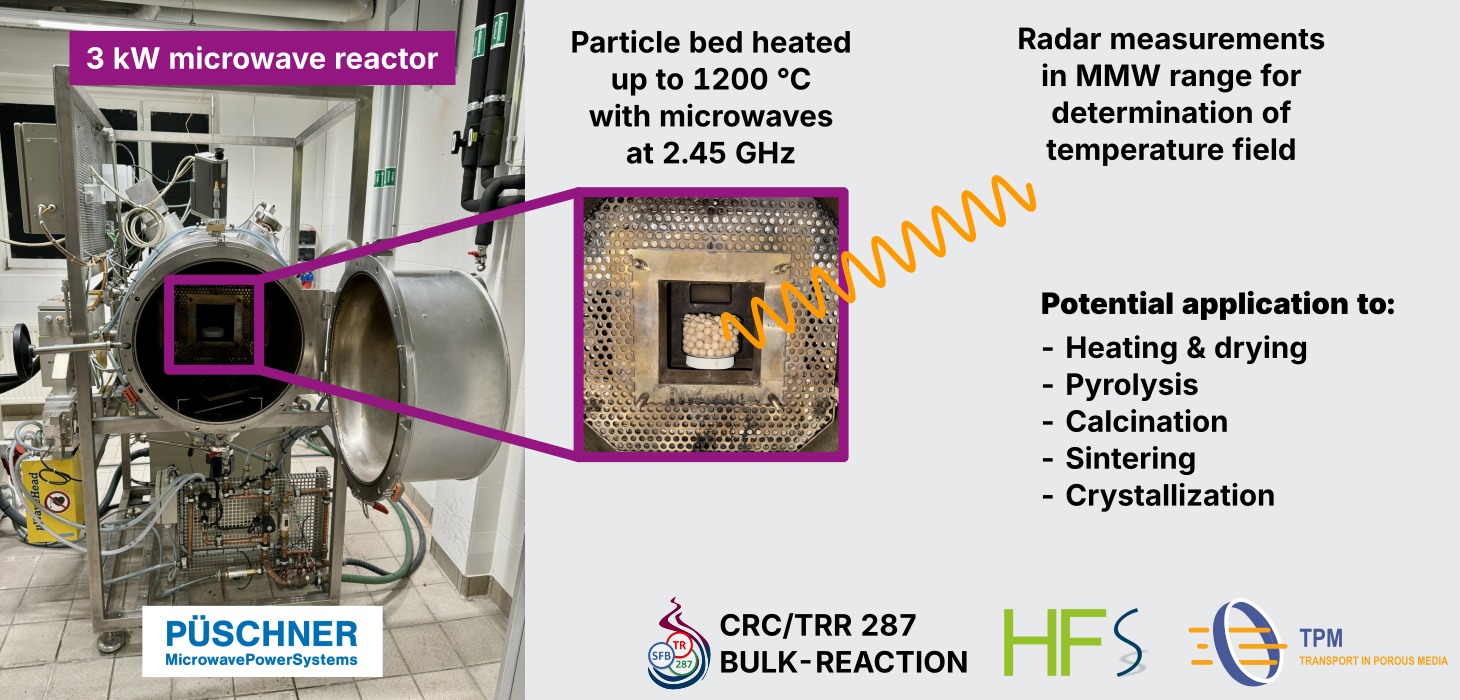
Electrification of thermal processes is key for the transformation of the industry towards carbon-neutral production. Depending on the technology, process intensification can be advanced in parallel to the defossilization. Microwave heating is very well known for its theoretically high energy efficiency. The fast internal heating additionally improves product yield and quality.
Pyrolysis of biomass, e.g. wood, is a promising conversion technology that enables production of feedstock chemicals from renewable resources, thus beeing an option for replacement of fossil resources like crude oil and gas. Microwave heating is knwon to affect the product quality and outcome composition during pyrolysis benefitially, while providing electrification of the process, therefore defossilization, as well.
But until now, an experimental gap hinders the advancement of microwave heating in high-temperature processes with phase change. So far, accurate models for high temperature microwave processes are not available. Operation of such processes is therefore hardly controllable. The overall conversion degree or inner material temperatures are not accessible inside of high-power electromagnetic fields.
In project B6 within the CRC/TRR 287 BULK-REACTION, we have the goal to develop a new measurement method that allows for the first time to monitor, both, material conversion due to phase changes and temperature inside of the products. This will be enabled by utilizing electromagnetic waves themselves for measurements, because their transmission, absorption and reflection is material composition and temperature dependent. Correlations of detected signals with material composition and temperature will be based on characteristic dielectric changes. 3D spatial resolution will be achieved by rotation of the sample during measurement. The experimental data sets will be combined with heat and mass transfer simulations, coupled with simulation of electromagnetic wave propagation, in order to gain a detailed insight into the thermal conversion processes.
Research partners
| Prof. Dr.-Ing. Jan Barowski |
University of Wuppertal Rainer-Gruenter-Str. 21 |
|---|---|
| Prof. Dr.-Ing. Alba Dieguez-Alonso |
Ruhr University Bochum Universitätsstraße 150 |
Publications
| Faber, F., Dernbecher, A., Gruber, S., Foerst, P., Dieguez-Alonso, A., & Vorhauer-Huget, N. (2026). Anisotropic Gas Permeability of Beech Wood from X-ray Microtomography and Pore Network Modeling: The Role of Vessels, Fibers, and Pyrolytic Conversion. Energy & Fuels, 40(39), 21866 – 21881 doi.org/10.1021/acs.energyfuels.6c03101 |
| Vorhauer-Huget, N., Ghasemi Monfared, Z., Kazemi, N., Arango Durango, E., Tsotsas, E., & Umeki, K. (2026). Effective thermal conductivity of packed bed of porous biochar particles. Particuology, 116, 437 – 447 doi.org/10.1016/j.partic.2026.06.036 |
| Zhan, N., Liu, E., Dernbecher, A., Vorhauer-Huget, N., Wu, R., Dieguez-Alonso, A., & Kharaghani, A. (2026). Detailed characterization of pore structure and transport properties of biomass particles during pyrolysis. Particuology doi.org/10.1016/j.partic.2026.08.001 |
| Dernbecher, A., Bhaskaran, S., Vorhauer-Huget, N., Seidenbecher, J., Gopalkrishna, S., Briest, L., & Dieguez-Alonso, A. (2025). Investigation on the intra-particle anisotropic transport properties of a beech wood particle during pyrolysis. Particuology, 98, 172 – 190 doi.org/10.1016/j.partic.2025.01.006 |
| Vorhauer-Huget, N., Seidenbecher, J., Bhaskaran, S., Schenkel, F., Briest, L., Gopalkrishna, S., Barowski, J., Dernbecher, A., Hilfert, L., Rolfes, I., & Dieguez-Alonso, A. (2024). Dielectric and physico-chemical behavior of single thermally thick wood blocks under microwave assisted pyrolysis. Particuology, 86, 291 – 303 doi.org/10.1016/j.partic.2023.07.004 |